
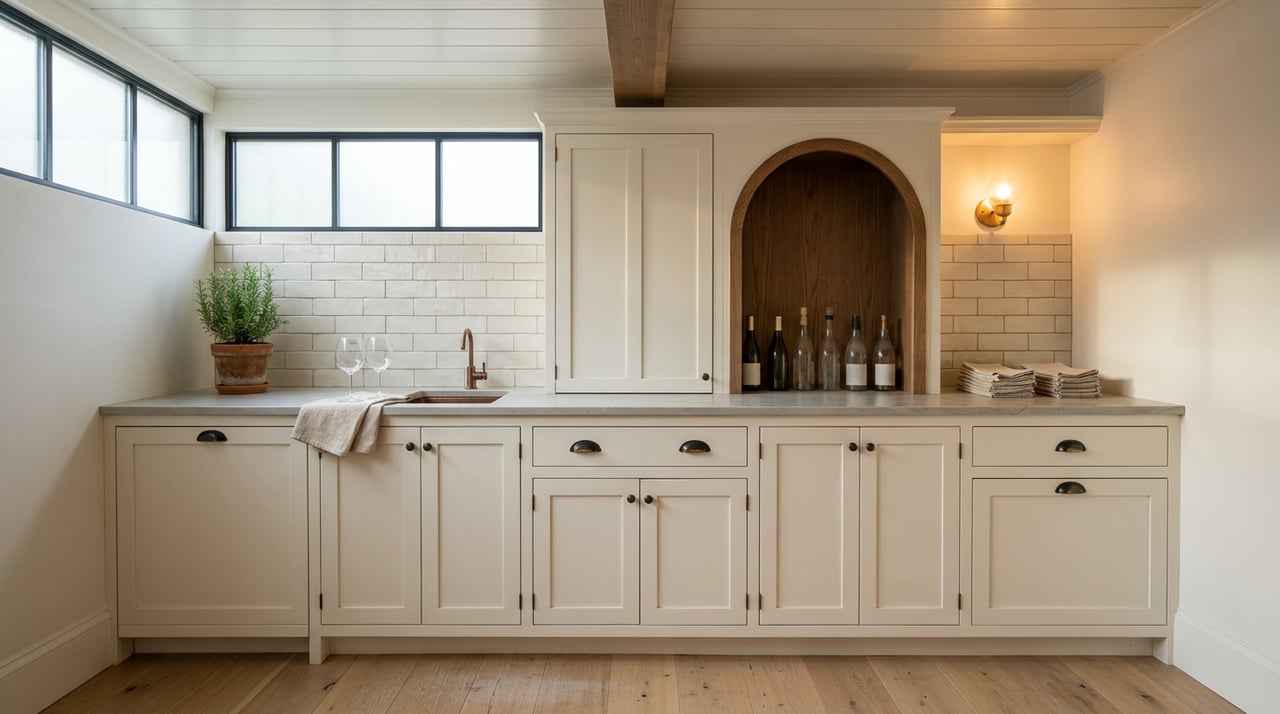
For a little over a year, the windows at 1313 East Sixth Avenue stayed dark. No paper on the glass, no lease sign, just a 48-seat dining room that had spent eighteen years as one of Denver's most quietly celebrated restaurants sitting empty on a block where almost nothing sits empty for long. If you walked past on your evening loop toward Cheesman Park, you'd have noticed it the way you notice a missing tooth: not dramatic, but impossible to unsee.
That gap tells you more about how this stretch of Country Club actually works than any list of what's currently open. The neighborhood's commercial edge along Sixth Avenue doesn't really do turnover in the way most restaurant corridors do, where a closed sign on Monday becomes a new logo by Friday. Here, when something leaves, the block seems to wait for the right successor rather than take the first offer. What finally arrived this spring makes that pattern explicit.
A Year of Dark Windows
Fruition opened in that space in 2007 under chef Alex Seidel and ran for eighteen years on a menu built around Colorado ingredients and unfussy technique. When it closed in 2025, it left behind not just a well-known address but a full wine cellar, a 48-seat floor plan, and a reputation that Denver diners had carried for nearly two decades. The space then sat unclaimed for over a year. Plans for a replacement weren't announced until December 2025, and the new restaurant, called Madeline, didn't open its doors until May 7, 2026, about four and a half months after those plans went public.
That's a long runway for a single storefront on a commercial block this small. Compare it to the churn you'd see on a strip like South Pearl or East Colfax, where a vacancy of a few months is already notable. On Sixth Avenue in Country Club, the wait wasn't a sign of neglect. It was closer to a search for the right heir.
What "Natural Successor" Actually Means
Madeline comes from chef Quincy Cherrett, whose résumé reads like a tour of Denver's serious kitchens: Sushi Den, Izakaya Den, Colt & Gray, Death & Co., and his own 22 Provisions food truck before he ran the bistro-style stall Eloise at Avanti Food & Beverage. This is his first standalone restaurant, and rather than gut the space and start over, his team kept the bones of what came before. Madeline inherited Fruition's wine cellar outright, and general manager Bryan Trott is building the new bar program on top of it, evolving the list around the restaurant's seasonal menu rather than replacing it wholesale.
Westword quoted the project architect, Kevin Nguyen of Regular Architecture, describing the decision in terms that read less like a renovation pitch and more like a statement of responsibility:
"Taking on a space as iconic as Fruition was both an honor and a responsibility."
That's not marketing language for a grand reopening. It's the language of someone who understood that this particular address came with expectations attached, and that the neighborhood would notice if those expectations weren't honored. The menu leans into that tension deliberately, blending Cherrett's Asian-kitchen training with the same technique-driven, ingredient-first sensibility Fruition was known for: dishes like oysters with radish and green apple mignonette, or a crab cake served with red miso shrimp bisque, sit alongside a roasted half chicken finished with laab dressing. It's a menu built to feel like a continuation, not a clean break.
Here's the short version of how the handoff actually played out:
- 2007 – Fruition opens at 1313 East Sixth Avenue under chef Alex Seidel.
- 2025 – Fruition closes after eighteen years.
- December 2025 – Plans for Madeline are announced, about four and a half months ahead of opening.
- May 7, 2026 – Madeline opens in the same space, inheriting Fruition's wine cellar.
Call it four and a half months from announcement to open, but well over a year from close to open. That's the real number worth sitting with. It's the difference between a space getting filled and a space getting chosen.
The Rest of the Block Never Blinked
While the restaurant scene at the eastern edge of the neighborhood spent a year in limbo, the rest of Country Club's small commercial footprint didn't move at all. Novo Coffee has held its spot as the neighborhood's coffee stop through the entire stretch, the kind of place residents mention not because it's new but because it's never not been there. A few doors down, The Lark has been the neighborhood's go-to for hostess gifts, baby gifts, and holiday décor since 1971, more than half a century of continuity on a block that measures its restaurant turnover in decades rather than seasons.
That contrast matters. Country Club isn't a neighborhood where everything is static, and it isn't one where everything is in flux. It's one where the retail and coffee anchors barely change while the marquee restaurant space undergoes a slow, deliberate succession every generation or so. If you've lived here through both the Fruition years and the wait that followed, you've watched the neighborhood prove that it treats certain addresses as something closer to an inheritance than real estate.
The Culture That Doesn't Need a Storefront
Not everything that defines daily life here happens behind a lease, either. On the 600 block of North Williams Street, neighbors have organized a recurring Front Yard Community Concert, an unticketed evening where residents bring lawn chairs and picnic blankets to hear a local group play its own compositions to kick off the summer. It's not a commercial venue, not a listed business, and not something you'd find by searching for events in Denver. It exists because a handful of neighbors decided it should, and it keeps happening because the block shows up for it.
That kind of self-organized culture fills a gap that commercial turnover can't. While Sixth Avenue was waiting for its next chef, the residential blocks nearby weren't waiting for anything. They were making their own calendar.
Why the Pace Matters If You Live Here
None of this is really about restaurants. It's about what continuity looks like on a block small enough that every change registers. Country Club's Sixth Avenue corridor isn't resistant to change. Fruition closed, and something new eventually took its place. But the year of dark windows, the inherited wine cellar, and an architect describing the project as a responsibility rather than an opportunity all point to the same thing: this stretch of the neighborhood expects its next chapter to answer to the one before it.
That's a useful thing to understand if you've lived here for years and have watched storefronts change hands exactly once or twice in that time. It's also the kind of detail that doesn't show up in a walk score or a demographic snapshot. It shows up when you notice that the coffee shop hasn't changed, the gift store has been there since before most residents were born, and the restaurant that finally reopened after a long wait chose to keep the wine cellar instead of starting over.
If you're weighing a move within Country Club, tracking a listing on this stretch, or just curious what a place like this is actually worth when the obvious comparisons don't hold up, Casey Perry Properties works this neighborhood closely enough to know the difference between a vacancy and a succession. Request a private consultation to talk through what's happening on your block and what it might mean for your own plans.