
If you have ever driven through Hilltop and wondered why one block feels storybook traditional while the next leans crisp and modern, you are seeing the neighborhood’s design history in real time. Hilltop is not a one-style enclave, and that is a big part of its appeal for buyers and homeowners who care about architecture. Understanding the key styles, the eras behind them, and the design rules that shape updates can help you read the neighborhood with more confidence. Let’s dive in.
Hilltop’s layered design identity
Hilltop is bounded by Colorado Boulevard, Alameda Avenue, Holly Street, and 8th Avenue. It is known as a largely residential neighborhood with tree-lined streets and notable architecture, which helps explain why the area feels both established and visually varied.
That layered look comes from how Hilltop grew over time. Early growth was shaped by the City Lateral Canal and streetcars, then the neighborhood expanded quickly after the 1920s. Denver Public Library’s Hilltop history notes that dwellings rose from 42 in 1928 to 728 in 1950, which helps explain why homes from several eras sit side by side.
A 1944 zoning map also showed nearly all of Hilltop zoned Residence A, allowing private homes up to 6,000 square feet and 35 feet tall. In practical terms, that history created a residential district with a strong single-family identity rather than a subdivision built all at once. When you walk or drive through Hilltop today, you see that evolution in the rooflines, setbacks, massing, and materials.
Tudor Revival stands out
One of the easiest Hilltop styles to spot is Tudor Revival. Graland’s Hilltop history notes that the neighborhood blossomed from the 1930s with Tudor, Prairie, and Streamline Moderne residences, making Tudor one of the clearest prewar design layers in the area.
Tudor Revival homes usually feature steep roofs, textured brick, stone, or stucco, narrow windows, decorated chimneys, and false half-timbering. In Hilltop, these homes often give a street a more romantic, old-world feel. They also tend to read as highly composed from the curb, with strong roof shapes and carefully detailed facades.
For buyers, Tudor homes often stand out because the style feels distinct and historic without being overly ornate. For homeowners considering updates, the original roofline, masonry, and window proportions usually carry much of the home’s character. Those are often the details that matter most when trying to preserve visual balance.
Prairie and Streamline Moderne add contrast
Hilltop is not only about revival architecture. Prairie and Streamline Moderne homes also appear in the neighborhood, and they give some streets a noticeably more modern edge, even when the homes date back decades.
Prairie style is known for horizontality, low roofs, wide eaves, and bands of casement windows. That creates a grounded, low-slung look that contrasts nicely with the vertical energy of Tudor homes. In Hilltop, Prairie homes help show how the neighborhood developed with more than one architectural idea in mind.
Streamline Moderne adds another layer. While the research highlights its place in Hilltop’s 1930s architectural mix, what matters most to a buyer is the visual effect. These homes can feel cleaner, simpler, and more forward-looking than nearby revival houses, which adds to Hilltop’s sense of design variety.
Ranch homes define the postwar years
A large part of Hilltop’s identity was shaped in the 1940s and 1950s. A Denver Westword history described Hilltop as being largely developed during those decades, with most homes suburban-style ranches.
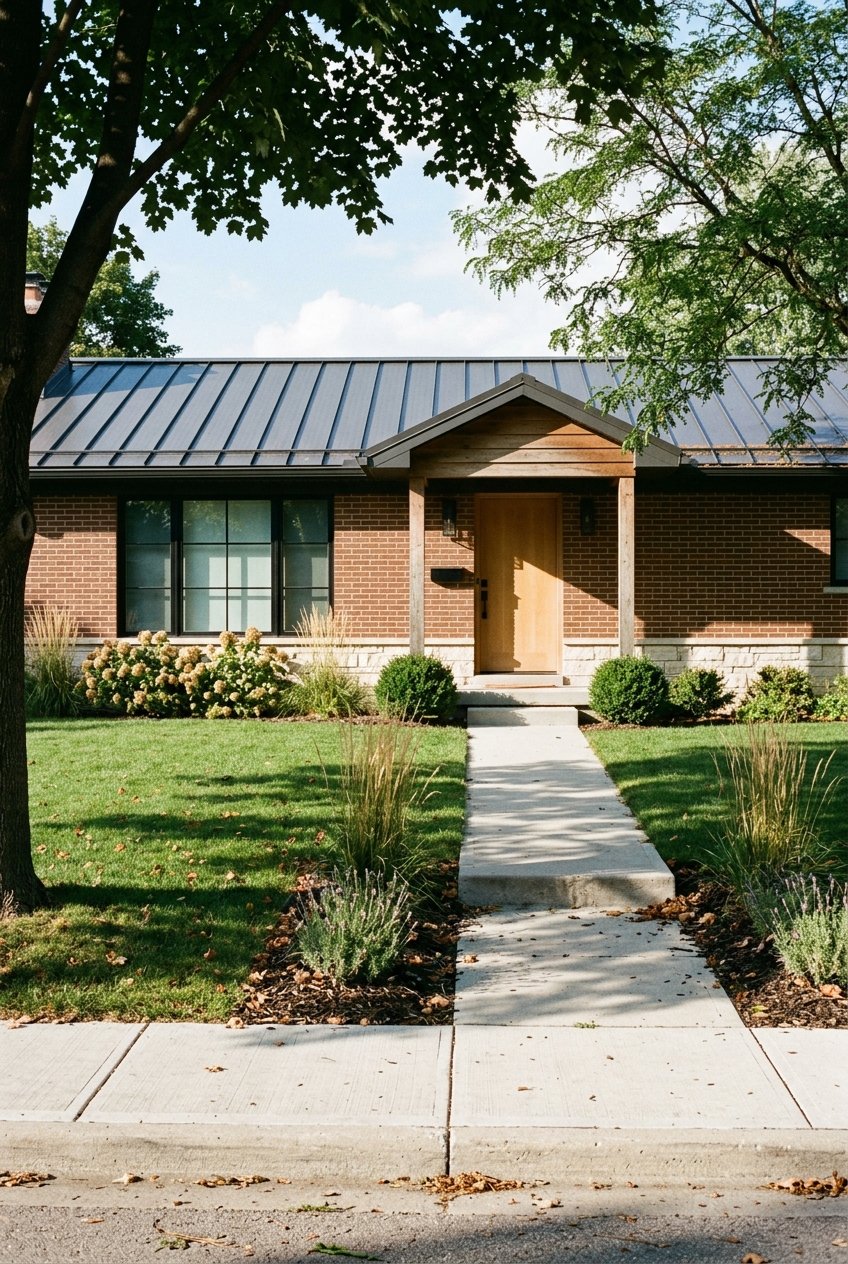
The ranch style is typically one story, low and horizontal, with a low-pitched roof, wide overhangs, an attached garage, a minimal porch, and an emphasis on picture windows. In Hilltop, ranch homes often represent the neighborhood’s more relaxed, postwar side. They can feel especially appealing if you value single-level living and a strong indoor-outdoor connection.
Design-wise, ranch homes are important because they set a different rhythm on the street. Their lower profiles, broader footprints, and simpler lines create contrast with taller traditional homes nearby. In a neighborhood like Hilltop, that contrast is part of what keeps the streetscape interesting.
Classic two-stories bring formality
Another common Hilltop type is the classic two-story home. A Denver housing survey describes the two-story Colonial Revival type as having two levels, a side-gabled roof, a symmetrical facade, shutters, and often an attached front-facing garage.
In Hilltop, these homes contribute a more formal and vertical presence. They often feel orderly and traditional from the street, especially when compared with the more casual look of ranch homes. That balance between formal two-stories and lower-profile ranches is one reason Hilltop does not feel architecturally repetitive.
For a buyer, this style difference can affect how a home lives day to day. Ranches often suggest easier flow on one level, while classic two-stories may feel more separated by function, with a more defined distinction between living and sleeping spaces. Neither is better in every case, but the experience is different.
Contemporary infill shapes the current chapter
Hilltop’s story did not stop in the mid-century era. Newer homes, additions, and pop-tops are now part of the neighborhood’s design conversation, which means contemporary architecture has a visible role in Hilltop today.
The city’s field guide describes International Style buildings as smooth, unornamented, flat-roofed, and banded with windows. In practice, newer Hilltop homes may borrow some of that cleaner language, even when they are not pure International Style buildings. The result is often a more contemporary look that stands apart from older houses while still working within neighborhood review standards.
That “while” matters. Denver’s conservation-overlay guidance notes that larger additions, pop-tops, infill, exterior remodels, and new builds are common review categories in Hilltop’s Heritage Conservation Overlay District. So even when a design is more modern, it still has to respond to the neighborhood’s scale and character.
Why scale and lot width matter
In Hilltop, architecture is not only about style. It is also about how a house sits on its lot and how its size relates to the homes around it.
Denver says Hilltop’s Heritage Conservation Overlay District is meant to conserve areas with distinctive character. The overlay applies to exterior remodels, additions, new builds, and vacant lots, which means visible changes are part of a larger neighborhood design framework.
Hilltop’s CO-1 zoning rules also limit the subdivision of older zone lots. If a lot existed on July 21, 2000, any new lots created from it must be at least 75 feet wide and 9,300 square feet. In simple terms, those standards help preserve Hilltop’s larger-lot feel and make scale, setbacks, and massing central to whether a home feels at home on the block.
For buyers and sellers, this matters because curb appeal in Hilltop is often tied to proportion as much as style. A successful home is usually one that respects the width of the lot, the rhythm of nearby houses, and the neighborhood’s overall sense of space.
Signature outliers keep Hilltop interesting
Even with recognizable style families, Hilltop includes homes that break the pattern in memorable ways. These outliers help explain why the neighborhood feels collected over time rather than uniform.
Hilltop’s story map describes the Leet home at 160 Bellaire Street with a wide turret, rusticated stone, covered porch arcades, gables, and an inset balcony. That composition reads as a late-Victorian or Queen Anne-era holdover and adds another historic note to the neighborhood’s mix.
The George Cranmer house at 200 Cherry Street is described as stucco with a tile roof, arcaded loggia, arched windows, and an ornate transom. That gives it a Mediterranean or Spanish-influenced character, which stands apart from Tudor and ranch homes nearby.
The Joshel House, documented by Denver Public Library as a Denver Landmark example of Second Phase International architecture, adds yet another design voice. Together, these homes show that Hilltop’s appeal comes from range as much as consistency.
What to notice when touring Hilltop
If you are exploring Hilltop as a buyer or simply studying the neighborhood more closely, a few design cues can tell you a lot. The most useful details to watch are roofline, window proportion, garage placement, lot width, and the way additions handle original massing.
A steep roof and masonry detailing may point to Tudor Revival. A long, low profile with wide overhangs may signal ranch or Prairie influence. A symmetrical two-story facade often suggests a more traditional Colonial Revival type, while flatter roofs and simpler surfaces can indicate more contemporary design.
It also helps to look at transitions. In Hilltop, the best additions and newer homes often feel intentional because they echo the neighborhood’s scale, setbacks, and materials rather than overpowering them. That visual discipline is a big part of what keeps the area cohesive.
Why Hilltop architecture matters in real estate
In a neighborhood like Hilltop, architecture is not just a backdrop. It shapes first impressions, influences how a home lives, and often affects how buyers connect emotionally to a property.
For sellers, understanding where a home fits within Hilltop’s architectural story can help frame its presentation. A Tudor may invite attention to masonry, rooflines, and period character, while a ranch may benefit from highlighting horizontal flow, natural light, and indoor-outdoor living. A newer home may stand out most when its scale and material choices feel well judged.
For buyers, style awareness helps you look beyond surface finishes. It gives you a clearer way to compare homes, understand what makes a property distinctive, and recognize when design updates strengthen the original architecture rather than compete with it.
If you are considering buying or selling in Hilltop, thoughtful local guidance can make a real difference. For discreet, research-driven advice tailored to Denver’s luxury neighborhoods, connect with Casey Perry.
FAQs
What architectural styles define Hilltop in Denver?
- Hilltop is known for a mix of Tudor Revival, Prairie, Streamline Moderne, ranch homes, classic two-stories, and newer contemporary infill, reflecting growth from the prewar and postwar periods.
What makes Tudor Revival homes in Hilltop easy to spot?
- Tudor Revival homes in Hilltop often feature steep roofs, textured brick, stone or stucco, narrow windows, decorated chimneys, and false half-timbering.
Why are ranch homes important to Hilltop’s identity?
- Ranch homes are central to Hilltop’s postwar character because much of the neighborhood developed in the 1940s and 1950s, when low, horizontal suburban-style homes became common.
What does the Hilltop conservation overlay affect?
- The Hilltop Heritage Conservation Overlay District applies to exterior remodels, additions, new builds, and vacant lots, with the goal of conserving the area’s distinctive character.
What should buyers notice when touring Hilltop homes?
- Buyers should pay close attention to roofline, window proportion, garage placement, lot width, and whether additions respect the home’s original massing and the scale of the surrounding street.
Why does Hilltop feel more varied than some Denver neighborhoods?
- Hilltop grew over several decades rather than in one single building period, so the neighborhood includes prewar revival homes, postwar ranches, formal two-stories, and contemporary updates on the same streets.